
Can You Prove Your AI Claims? A Practical Framework for Enterprise Leaders
Learn how enterprise leaders can substantiate AI-powered, predictive, privacy and performance claims—reducing procurement friction, contractual exposure and AI-washing risk.
Lewis Ho

AI marketing claims are no longer just marketing. They influence enterprise procurement, security reviews, contract negotiations, regulatory scrutiny, and customer trust. Enterprise leaders should treat material AI claims as commercial commitments, not creative language.
When Marketing describes a product as “AI-powered,” “predictive,” “real-time,” “privacy-safe,” or “hallucination-free,” sophisticated buyers will ask a simple question: Can you prove it?
A defensible AI claim has five characteristics:
Specific — it describes a real capability rather than vague technological aspiration.
Supported — it is backed by current technical, security, privacy, and product evidence.
Qualified — it states the operating conditions, limitations, and relevant definitions.
Consistent — Sales, Product, Engineering, Legal, and Customer Success describe it in the same way.
Governed — there is a named owner, an approval process, and a trigger for review when the product changes.
Done well, AI claims governance could become a sales-enablement system that gives enterprise customers confidence that the company understands both its technology and its obligations.

The Five AI Claims That Require the Most Discipline
1. “AI-Powered”
“AI-powered” should mean more than a modern interface wrapped around legacy rules or static reporting. The issue is whether the language accurately describes the source of customer value.
Questions leadership should ask:
What AI capability is actually deployed?
Is it central to the product’s stated value proposition or merely an optional feature?
Does the product use machine learning, a generative model, statistical modelling, or rules-based automation?
Is human review part of the workflow?
Can customers use the core product without the AI feature?
Better Language
Instead of:
“Our platform uses autonomous AI to transform decision-making.”
Consider:
“Our platform uses machine-learning models to identify patterns in defined operational data and support prioritisation within approved workflows.”
Or:
“The platform combines rules-based workflow automation with AI-assisted content generation and retrieval-grounded recommendations.”
Specificity does not weaken the claim. It makes it more credible.
2. “Predictive”
“Predictive” is a performance claim. It should describe what outcome is being predicted, for whom, over what time horizon, and under what conditions. A system that analyses historical trends or produces a dashboard is not necessarily predictive in the commercial sense customers may infer.
Questions leadership should ask:
What outcome is the system predicting?
What is the prediction horizon?
What data is used?
What is the relevant performance metric?
How does performance vary across customer segments, geographies, or data conditions?
What human judgement remains necessary?
Depending on the claim and use case, you may need the below evidence:
documented testing methodology;
definitions for accuracy, precision, recall, F1 score, or other relevant metrics;
out-of-sample validation;
comparison with a baseline method;
confidence thresholds;
segment-level performance analysis;
model-monitoring and drift procedures.
Better language
Instead of:
“Our AI accurately predicts customer churn.”
Consider:
“The platform is designed to estimate churn risk using historical and current customer-activity signals. Performance depends on data quality, customer segment, and deployment conditions.”
If a performance number is used, define it:
“In a defined validation dataset, the model achieved 94.2% recall for identified high-risk accounts.”
A number without a method invites scrutiny. A number with context can accelerate diligence.
3. “Real-Time”
“Real-time” is not a synonym for fast. For one use case, real-time may mean milliseconds. For another, it may mean a response within several seconds. For a reporting workflow, it may mean updates every few minutes. The appropriate standard depends on what the customer reasonably expects.
Questions leadership should ask:
Is the claim about model-response time, API latency, or end-to-end business-process completion?
Is data processed continuously, in batches, or through scheduled jobs?
What are the p50, p95, and p99 latency figures?
What happens at peak usage?
Which third-party dependencies affect performance?
Is the claim a product description or a contractual service-level commitment?
Better language
Instead of:
“Guaranteed real-time processing.”
Consider:
“The platform processes eligible transactions with a median end-to-end response time of under one second in the documented operating environment.”
Or:
“Near-real-time updates are typically available within five minutes of event ingestion.”
The second version may appear less dramatic. It is also more likely to survive technical diligence.
4. “Privacy-Safe,” “Zero Retention,” or “Zero Data Risk”
Privacy and security claims require particular caution because buyers may interpret them as guarantees.
A company should not say “privacy-safe” unless it can explain what that means in practice: what data is processed, where it goes, whether it is retained, whether it is used for model training, who can access it, and what controls apply.
Questions leadership should ask:
What customer data is sent to the model or service provider?
Is data retained, logged, or used to improve any model?
What configurations and contractual terms control retention?
Which subprocessors are involved?
Is data encrypted in transit and at rest?
What customer controls, deletion processes, and access restrictions exist?
Does the product process personal data, confidential information, regulated data, or all three?
Better language
Instead of:
“Your corporate data is 100% protected.”
Consider:
“Customer content is encrypted in transit and at rest, and is not used to train our models under the applicable enterprise service configuration.”
Instead of:
“Zero-retention AI.”
Consider:
“The service is configured not to retain customer prompts beyond the period required to provide and secure the service, subject to the applicable product configuration and contract terms.”
This is more precise and gives buyers a clear basis for further diligence.
5. “Consent-Based,” “Ethically Sourced,” or “IP-Safe”
Data provenance claims should not rely on shorthand. “Consent-based” may not be the relevant legal basis for every type of data. Rights to use data can arise from contracts, licences, statutory permissions, legitimate business purposes, or other lawful grounds, depending on the data and jurisdiction.
The important question is whether the company can demonstrate the right to use the data for the relevant purpose.
Questions leadership should ask:
Can we identify the source of the data?
What rights, permissions, licences, or lawful bases support its use?
Do contractual restrictions limit model training or downstream use?
How are withdrawals, deletions, or objections handled where relevant?
Do we distinguish between personal data, customer content, public data, and licensed datasets?
Better language
Instead of:
“Trained exclusively on 100% consent-cleared data.”
Consider:
“We maintain a documented data-governance and rights-clearance process for data used in our products and model-development workflows.”
Where a more specific claim is accurate:
“Customer content is not used to train shared models without the customer’s express agreement.”
Vendor Terms Do Not Automatically Prove Your Claim
Many enterprise products use third-party cloud infrastructure, foundation models, APIs, vector databases, security tools, and data services. That does not mean the downstream product automatically inherits every upstream provider’s security, privacy, accuracy, or compliance posture.
The customer evaluates the product they are buying from you. Your application layer may introduce additional risks through system prompts, retrieval-augmented generation, access controls, user permissions, logging settings, output processing, third-party integrations, and human-review workflows. Thus, leadership should distinguish between:
What the upstream provider contractually commits to;
What the company’s own product architecture does; and
What the company is representing to customers.
A reliable upstream provider is valuable. It is not a substitute for product-level substantiation.

AI Claims Management System
To stay efficient without forcing every claim through a lengthy legal review, organizations could build a system that allows approved claims to move quickly and unsupported claims to be corrected early.
1. Create a Pre-Approved Claims Library
The library should contain approved wording for common claims, such as "AI-powered," "machine-learning-assisted," "predictive," "real-time or near-real-time," "human oversight," and "model accuracy." Each claim should identify:
Approved wording e.g. “Uses retrieval-grounded generation to assist users in drafting responses based on authorised knowledge sources.”
Product scope e.g. Named product and feature version
Evidence owner e.g. Head of Product / ML Engineering
Evidence source e.g. Architecture document and validation record
Limitations e.g. May require human review; output depends on source quality
Approved channels e.g. Website, pitch deck, RFP response
Review date e.g. Quarterly or upon material product change
This gives Sales useful language without encouraging improvisation.
2. Maintain an Evidence Register
Every significant claim should link to its supporting evidence. Evidence may include feature specifications, test plans and results, performance metrics, data-flow diagrams, vendor agreements and configuration records, security assessments, data-source and rights-clearance records, incident-response documentation, and model-monitoring reports.
The evidence should be proportionate. A general “AI-assisted workflow” claim does not require the same documentation as a claim of specific predictive performance in a high-risk business process.
3. Establish a Fast-Track Review Process
A practical model categorizes claims into pre-approved claim which is immediately available for use, and new or high-risk claim which has to be reviewed by Product/Engineering, Legal, Privacy/Security, and Marketing within a defined service level.
The decision should be simple. It is either approved with evidence supporting the claim, or approved with qualifications and illustrate operating limits, or not approved at all.
The AI Claim Evidence Pack
A company does not need one enormous dossier for every statement. It needs an organised, proportionate evidence pack for material claims.
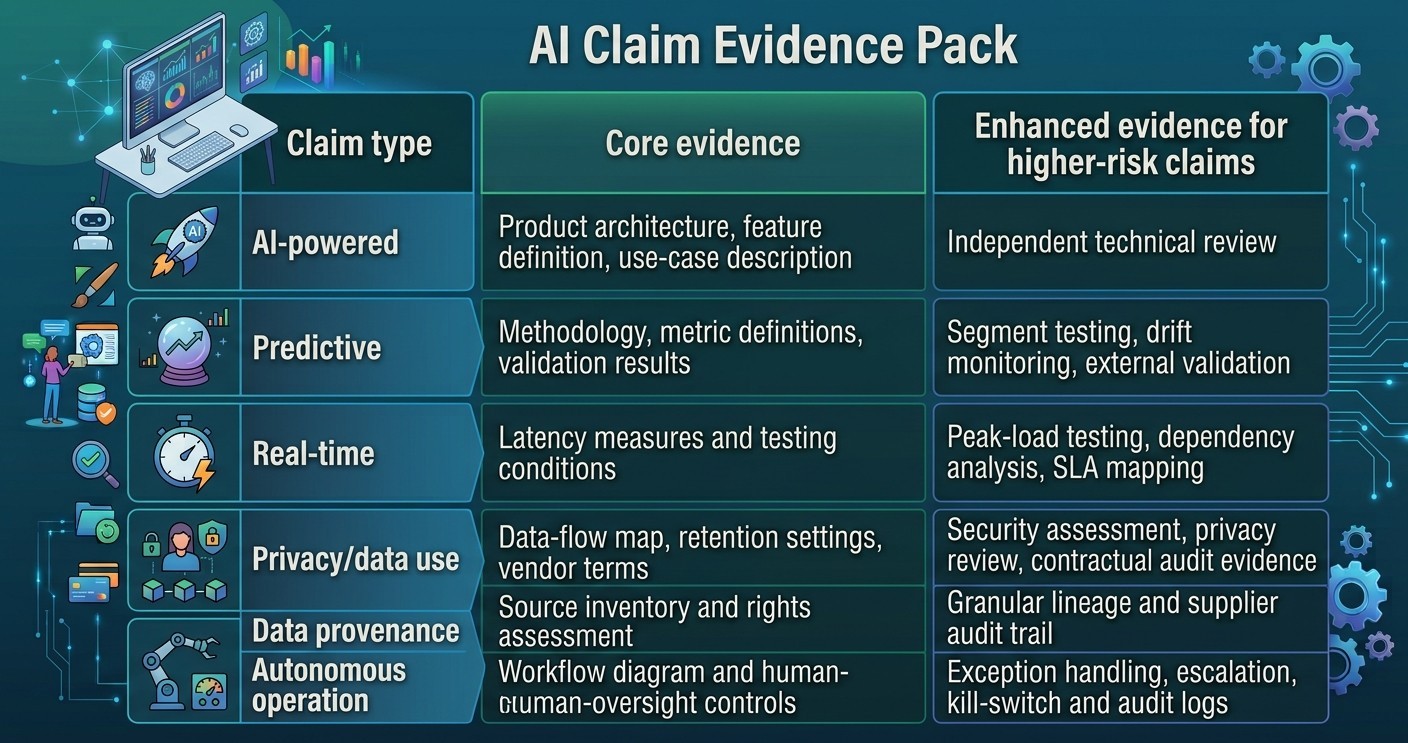
The key is traceability. A senior leader should be able to ask, “What supports this claim?” and receive a clear answer promptly.

Board-Level Questions for AI Claims Governance
Boards and executive committees do not need to approve every piece of marketing copy. They should ensure that an effective governance system exists. Useful board questions include:
Which AI claims are most important to our revenue strategy?
Which claims create the greatest contractual, privacy, regulatory, or reputational exposure?
Do we have a current inventory of public AI claims?
Is every material claim owned by a Product, Engineering, Legal, or Security leader?
What evidence supports our highest-risk claims?
What triggers claim revalidation after a product, model, vendor, or configuration change?
Are public claims consistent with our standard contracts and security documentation?
Conclusion: Proof Is a Commercial Advantage
For LexGuard AI, proof is not a marketing exercise, it is a governance capability.
Enterprise leaders need to know not only what their AI systems can do, but also what the organisation can credibly say about them to customers, regulators, investors, and business partners.
LexGuard helps organisations turn AI claims into defensible operating practice: clear ownership, documented evidence, appropriate controls, stronger vendor terms, and consistent answers across Legal, Security, Procurement, Product, and the board.
The result is not simply lower risk. It is greater confidence to adopt, procure, sell, and govern AI at enterprise scale.
What does it mean to substantiate an AI claim?
To substantiate an AI claim means having credible, current evidence that supports what your company says its AI product can do. For example, a claim that a platform is “predictive,” “real-time,” or “privacy-safe” should be backed by documentation such as product architecture, testing results, performance metrics, data-flow maps, security assessments, and applicable vendor terms. Enterprise leaders should also be able to explain the claim’s scope, assumptions, and limitations.To substantiate an AI claim means having credible, current evidence that supports what your company says its AI product can do. For example, a claim that a platform is “predictive,” “real-time,” or “privacy-safe” should be backed by documentation such as product architecture, testing results, performance metrics, data-flow maps, security assessments, and applicable vendor terms. Enterprise leaders should also be able to explain the claim’s scope, assumptions, and limitations.
What AI marketing claims create the most risk for enterprise companies?
The highest-risk AI claims are usually broad, absolute, or performance-based statements. Common examples include “AI-powered,” “fully autonomous,” “hallucination-free,” “100% accurate,” “real-time,” “zero retention,” “privacy-safe,” and “ethically sourced data.” These claims can affect enterprise procurement, security reviews, customer contracts, and regulatory scrutiny. Companies should use precise, qualified language and maintain evidence that supports each material statement.
How can enterprise leaders govern AI claims without slowing down Sales?
The most effective approach is to create a pre-approved AI claims library. This gives Sales and Marketing approved wording for common product, privacy, security, performance, and data-use claims, along with the supporting evidence, limitations, and approved channels for use. For new or high-risk claims, establish a fast-track review process involving Product, Engineering, Legal, Privacy, and Security. This allows teams to respond quickly to customer and RFP questions while reducing the risk of unsupported or inconsistent AI statements.