
Enterprise AI Governance: A Practical Risk-Tiering Framework for Enterprises
A practical enterprise AI risk tiering framework that distills the most useful elements of NIST, the EU AI Act, the UK ICO, Singapore, China and Hong Kong into one clear model, with framework design guidance, operating structure, and common pitfalls senior executives should avoid.
Lewis Ho

To build a practical, scalable and defensible approach to AI governance, the most effective starting point is a risk-tiering framework. Rather than treating all AI use cases alike, a tiering model helps leaders distinguish low-risk productivity uses from applications that may affect people, customers, rights, regulated processes, or external outcomes. Done well, it supports innovation while giving legal, risk, compliance, technology, and business teams a shared basis for oversight.
A strong enterprise AI governance framework should be simple enough for business teams to apply, robust enough for regulators and boards to respect, and flexible enough to accommodate different jurisdictions. The best approach is not to replicate every global AI law inside the organization. It is to build a clear internal model grounded in recognized international frameworks, including the NIST AI Risk Management Framework, the EU AI Act, guidance from the UK ICO, Hong Kong’s privacy and AI governance guidance, Singapore’s practical governance models, and relevant China considerations for public-facing or content-generating AI.
The result should be a governance system that is proportionate, operational, and commercially usable.
Why AI Risk Tiering Matters for Enterprise Governance
Without a tiering system, organizations tend to fall into one of two errors. They either over-govern everything, which slows adoption and frustrates the business, or they under-govern important use cases, which creates avoidable risk. A tiered model solves that problem by applying governance in proportion to the significance of the use case.
An internal tool that summarizes non-sensitive meeting notes should not go through the same review as an AI system used to screen job candidates. A marketing assistant drafting preliminary copy is not equivalent to a chatbot giving customer guidance in a regulated sector. A code assistant operating under developer review is different from an automated tool that influences eligibility, pricing, access, or employee treatment.
For senior executives, the purpose of AI risk tiering is straightforward: match the level of governance to the level of risk created by the use case.
That requires a framework focused on business impact, not technical novelty. A sound enterprise AI tiering system should be simple enough for business leaders to use, credible enough for legal and risk teams to support, and flexible enough to work across multiple jurisdictions. In practice, the strongest approach is to combine the best ideas from leading frameworks rather than relying on any single one.
The International Foundations of a Strong Enterprise AI Governance Framework
A practical enterprise framework should draw from leading AI governance and data protection models without becoming a legal encyclopedia. Each framework contributes something useful.
NIST AI RMF: Manage AI as an Enterprise Risk
The NIST AI Risk Management Framework is a strong foundation because it treats AI risk management as an ongoing management discipline — “Govern, Map, Measure, Manage”. AI risk does not arise only when a system goes live. It can emerge during procurement, design, configuration, data selection, testing, deployment, user adoption, monitoring, vendor updates, and retirement.
For non-AI-service-provider enterprises, this lifecycle view is particularly useful. Most companies will not build every AI system themselves. Many will procure AI-enabled tools from vendors, configure them for internal use, and integrate them into existing business processes. Governance therefore needs to address not only technical performance, but also ownership, documentation, testing, accountability, monitoring, and continuous improvement.
NIST’s value lies in making AI governance part of enterprise risk management rather than a standalone technology exercise.
EU AI Act: Apply More Control to More Consequential Uses
The EU AI Act is important because it establishes a clear risk-based logic: different AI uses deserve different levels of scrutiny.
Enterprises do not need to copy the Act’s legal categories wholesale into their internal policies. But the underlying principle is highly relevant. AI applications that influence employment, access to services, safety, regulated decisions, or treatment of individuals require stronger governance than low-risk internal productivity tools.
Even where an enterprise operates outside the EU, the Act has become a reference point because it introduces hard governance triggers. Regulators increasingly expect organizations to know where AI is being used, assess the risk of those uses, document appropriate safeguards, and maintain accountability.
UK ICO and Hong Kong PDPO: Keep Privacy, Fairness, and Human Oversight at the Center
The UK Information Commissioner’s Office and Hong Kong’s privacy regulator have both emphasized issues that matter directly to enterprise users of AI: lawful and responsible data use, fairness, transparency, accountability, explainability, and human oversight.
These themes are especially relevant because many seemingly “ordinary” AI use cases in HR, customer operations, fraud, analytics, and support functions become materially more sensitive as soon as personal data enters the workflow. AI may be used to analyze employee data, personalize customer interactions, support compliance review, prioritize leads, manage complaints, or generate communications. In each case, the organization remains responsible for how data is used and how decisions are made.
The UK ICO and Hong Kong guidance help ground AI governance in familiar corporate responsibilities: handling personal data properly, ensuring fair outcomes, maintaining appropriate transparency, and keeping meaningful human judgment where it matters.
Singapore’s Model AI Governance Framework: Make Governance Practical
Singapore asks management to think about how governance actually functions inside the enterprise. The focus on internal governance structures, clear roles, explainability, fairness, and human-centric deployment makes it especially useful for moving from principle to operating model. The 2026 agentic AI framework further sharpens the governance challenge by emphasizing autonomy, system permissions, and human accountability for AI that can act rather than merely recommend. The governance impact is that the organization must design controls around authority, access, action, and oversight, not just output quality.
Singapore’s contribution is a useful reminder: good governance must be usable governance. It requires ownership, documented review, defined accountability, and processes that business teams can actually follow without creating unnecessary friction.
China: Treat Local Requirements as an Overlay, Not the Core Model
Mainland China’s AI regulatory approach is relevant for multinational companies, particularly where AI is public-facing, content-generating, recommendation-based, or connected to internet platform services. Multinational companies using AI in China-facing customer channels, online services, generated content, or external communications should route those use cases for specific legal and compliance review.
For ordinary internal AI use, China’s role in the enterprise framework is more limited. It should function as a jurisdictional checkpoint, not the foundation of the global model.
The better approach is to treat China, and other jurisdiction-specific requirements, as overlays. If a use case will be deployed in China or another market with specific AI, privacy, content, or sectoral rules, it should receive targeted legal and compliance review. The enterprise-wide framework should remain simple, risk-based, and globally usable.

Designing a Tiering System By Taking The Best From Each Framework
The proposed enterprise tiering system is built by taking the strongest and most practical element from each authority. The strongest model is:
risk-based, so oversight matches impact;
use-case-based, so classification reflects business reality;
lifecycle-based, so governance continues after launch;
accountable, so ownership is clear;
globally aware, so local requirements are addressed where relevant;
operational, so teams can use it without unnecessary delay.
NIST provides the enterprise risk foundation. The EU AI Act reinforces risk-based escalation. The UK ICO and Hong Kong emphasize privacy, fairness, accountability, and human oversight. Singapore keeps the model practical. China serves as a reminder that certain public-facing or content-related uses may require jurisdiction-specific review.
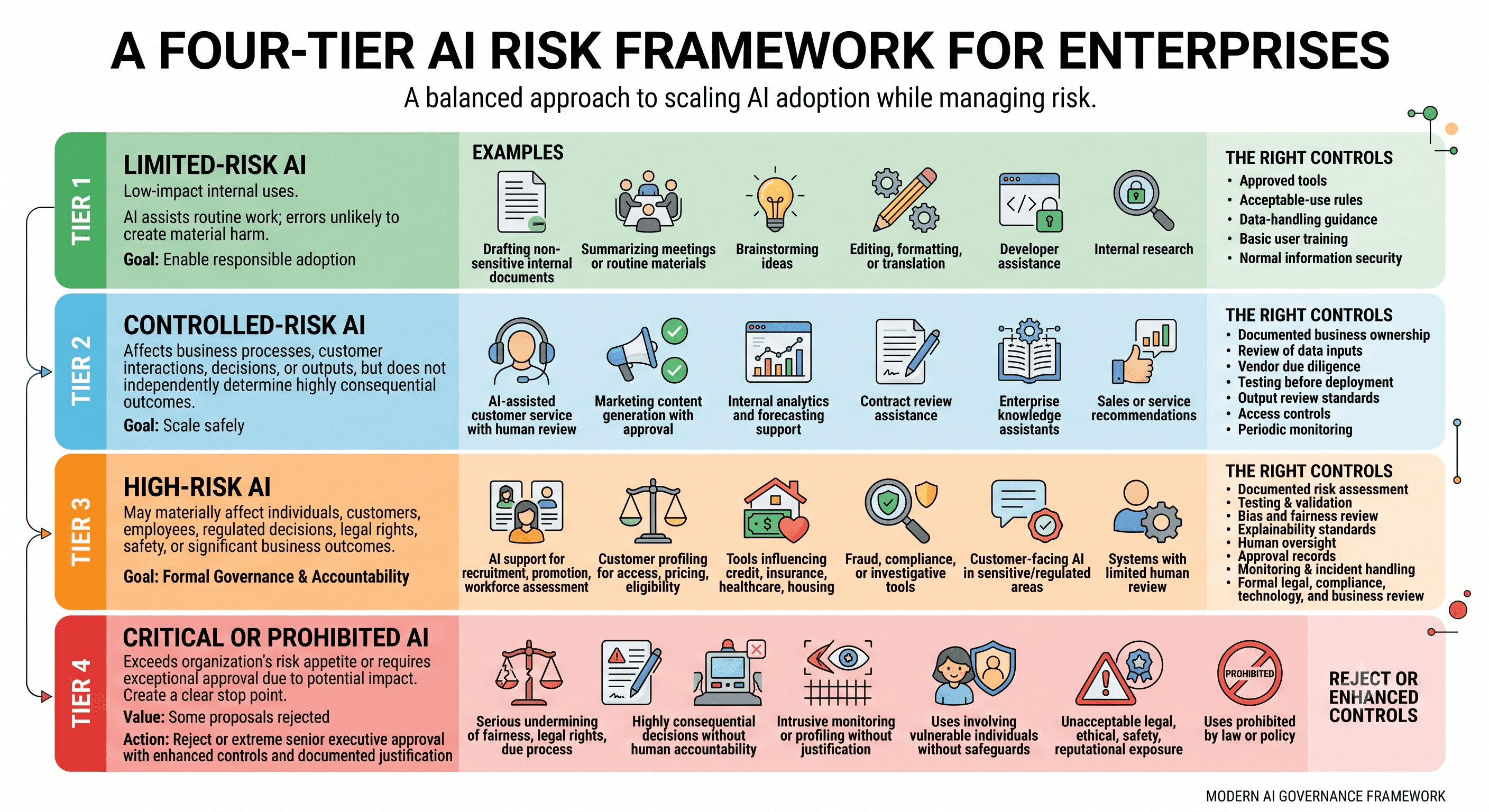
No single framework should dominate the entire design. The goal is a usable enterprise system that reflects the best of these sources while remaining clear enough for the business to adopt. And for most non-AI-service-provider companies, a four-tier model is sufficient.
Tier 1 — Limited Risk
These are assistive, low-impact internal uses where AI supports routine work, sensitive data is not used, and any errors are unlikely to create material harm.
Common examples include:
drafting or summarizing non-sensitive internal content;
summarizing routine internal documents;
brainstorming ideas;
formatting, editing, or translation support for low-risk content;
software development assistance where standard code review remains in place;
internal research support using approved tools and non-sensitive information.
These use cases should not require heavy governance. The right controls are straightforward: approved tools, acceptable-use rules, data-handling guidance, basic user training, and normal information security practices. The goal is to enable responsible adoption without unnecessary friction.
Tier 2 — Controlled Risk
Controlled-risk AI includes use cases that affect business processes, customer interactions, internal decisions, or operational outputs, but do not independently determine highly consequential outcomes.
Examples include:
AI-assisted customer communications subject to human review;
internal analytics and forecasting support;
contract review assistance;
marketing content generation with approval controls;
enterprise knowledge assistants using internal information;
sales or service recommendations that inform, but do not determine, business action.
These use cases need more structure. Appropriate controls may include documented approval, defined business ownership, review of data sources, vendor due diligence, baseline testing for accuracy, hallucination and leakage, output review standards, access controls, and periodic monitoring.
Tier 3 — High Risk
These are uses where errors, bias, opacity, or misuse could materially affect individuals, customers, employees, regulated decisions, legal rights, safety or significant business outcomes.
Examples include:
AI support for recruitment, screening, promotion, or workforce assessment;
customer profiling that materially affects access, pricing, eligibility or treatment;
tools that influence credit, insurance, health, education, or financial decisions;
AI used in disciplinary, fraud, compliance, or investigative contexts;
customer-facing AI providing guidance in sensitive or regulated areas;
systems where human review is limited or may become a rubber stamp.
These uses require formal review and stronger controls. Legal, privacy, compliance, security, technology risk, and business leadership should be involved as appropriate. Controls should include documented risk assessment, testing, validation, bias and fairness review where relevant, explainability standards, human oversight, approval records, monitoring, incident handling, and periodic reassessment.
For Tier 3, the company should be able to explain not only how the tool works, but why its use is appropriate, who is accountable, and how risks are controlled.
Tier 4 — Critical or Prohibited AI
These are uses that exceed the organization’s risk appetite or require exceptional approval because of their potential impact.
Examples may include:
AI uses that seriously undermine fairness, legal rights or due process, such as AI embedded in clinical decision workflow, AI materially determining employment outcomes at scale;
Highly consequential decisions made without meaningful human accountability, such as autonomous execution of financial transfers or account restrictions;
Intrusive monitoring or profiling of employees or customers without strong justification;
uses involving vulnerable individuals without adequate safeguards;
uses that create unacceptable legal, safety, ethical or reputational exposure;
uses prohibited by applicable law or internal policy.
Tier 4 should be rare. Its value is to create a clear stop point. Some proposals should be rejected. Others may proceed only with senior executive approval, enhanced controls, and a documented justification. A mature AI governance framework must make room for both outcomes.

Key Questions for Assigning the Right AI Risk Tier
The tiering process should be clear enough for business leaders to understand and consistent enough for control functions to apply. A short set of questions will usually identify the right path.
1. What is the AI being used to do?
Routine productivity support is different from decision support, customer engagement, employee assessment, or regulated activity.
2. Who could be affected?
The risk increases when the use affects employees, job applicants, customers, patients, consumers, counterparties, or the public.
3. What data is involved?
Use of personal data, sensitive data, confidential business information, regulated data, or children’s data requires greater scrutiny.
4. What are the consequences of error?
A minor inconvenience is one thing. Financial loss, unfair treatment, denial of opportunity, legal exposure, safety risk, or reputational harm is another.
5. How much human judgment remains?
Human oversight must be meaningful. If people rarely challenge the AI output, the system may be operating with more autonomy than the policy suggests.
6. Is the use internal, external, or public-facing?
External and public-facing uses generally require stronger controls, particularly where customers may rely on the output.
7. Does the AI influence important decisions?
Employment, eligibility, access, pricing, treatment, compliance, safety, and disciplinary decisions should trigger heightened review.
8. Are there jurisdiction-specific requirements?
Deployment in markets with specific AI, privacy, content, cybersecurity, or sectoral rules should trigger targeted legal review. This is where China, Hong Kong, the EU, the UK, Singapore, and other local considerations should be applied without overcomplicating the global framework.
Operating Model: How the Framework Works in Practice
A governance framework succeeds only if it becomes part of normal business operations.
1. Intake
Every AI use case should begin with a short but structured intake process. The business owner should identify:
the business purpose;
the AI tool or vendor
owner, the expected users, and affected stakeholders;
data involved;
whether the use is internal, external or public-facing;
whether outputs influence decisions;
autonomy level and proposed human oversight;
deployment jurisdictions;
expected benefits and key risks;
fallback process.
The intake should be concise. Its purpose is to reveal risk, not create paperwork.
2. Triage
The use case should receive a provisional tier based on the intake. Low-risk uses can move quickly under standard controls. Higher-risk uses should be routed to the right reviewers.
Triage should be predictable. Business teams need to know what triggers legal, privacy, security, procurement, compliance, HR, or senior management involvement
3. Review and Approval
The depth of review and governance approach should match the tier.
Tier 1: Approved tools, user guidance, basic training, standard security controls
Tier 2: Business ownership, documented review, vendor checks, data controls, testing, monitoring
Tier 3: Formal cross-functional review, risk assessment, legal/privacy/security approval, human oversight, monitoring
Tier 4: Senior escalation, exceptional approval, enhanced controls, or rejection
This structure allows the company to move quickly where risk is low and slow down where judgment is needed.
4. Monitoring
Governance should not end at launch. The organization should monitor whether the use remains within its approved scope, whether issues have arisen, whether the human oversight model is working, and whether changes in law, vendor capability, or business use require re-evaluation. Use cases should be re-tiered if there is:
a new model or vendor;
expanded users or geography;
new data sources;
increased autonomy;
new customer-facing functionality;
an incident, complaint, or near miss;
a regulatory change.

What This Means for Senior Executives
A strong tiering system helps leadership do four things well.
First, it encourages adoption of lower-risk, high-value uses without unnecessary delay.
Second, it ensures that higher-risk uses receive the scrutiny they deserve before they become operationally embedded.
Third, it creates a defensible structure for accountability across business, legal, risk, privacy, security, and technology teams.
Fourth, it helps the company remain globally credible by accommodating local legal expectations where necessary without making the overall governance model too complex to use.
All in all, it creates a common language for business growth, risk management, legal compliance, technology governance, and board oversight.
Common Pitfalls to Avoid
Even sophisticated companies can weaken AI governance by making avoidable mistakes.
Overengineering the framework
A framework that tries to encode every jurisdiction and every legal nuance will be difficult to use. Keep the core model simple. Handle local requirements through overlays and targeted review.
Treating all AI use as high risk
This discourages adoption and drives activity outside formal channels. Governance should be proportionate.
Focusing only on tools, not use cases
The same tool can create different risks in different contexts. Classify the use case.
Assuming human review solves everything
Human oversight only works if reviewers have authority, time, competence, and a genuine ability to challenge the AI output.
Ignoring vendor-enabled AI
Many enterprise AI risks enter through existing software providers. Procurement, vendor management, security, and legal teams should be part of the governance model.
Letting pilots become production systems
AI experiments can quickly become embedded in business processes. Define when pilots require formal review before scaling.
Conclusion
For non-AI-service-provider enterprises, the best AI governance model is practical, proportionate, and business-facing.
It should treat AI as an enterprise risk that must be governed across its lifecycle. It should recognize that some use cases are more significant than others. It should give proper weight to privacy, fairness, explainability, and human oversight. It should be operational enough for business teams to use in practice. And it should allow for jurisdiction-specific review, including in places such as Hong Kong and China, without turning the entire framework into a technical compliance exercise.
In short, the right question is not whether a company has “an AI policy.” The right question is whether it has a clear, workable way to distinguish ordinary AI use from consequential AI use, and to govern each accordingly.
That is what a good tiering system provides.
1. What is an enterprise AI governance framework any why does it matter?
An enterprise AI governance framework is the structure a company uses to identify, assess, approve, monitor, and control AI use across the business. It matters because AI is now embedded in routine operations, customer interactions, decision support, and vendor platforms. A strong framework helps organizations apply proportionate oversight, reduce legal and operational risk, and support responsible AI adoption at scale.
2. How can companies build a practical AI risk tiering framework?
Companies can build a practical AI risk-tiering framework by classifying AI use cases based on business impact, data sensitivity, degree of autonomy, human oversight, and the consequences of error. The most effective model is use-case-based, lifecycle-based, and globally aware. It should combine the strongest elements of leading frameworks such as NIST, the EU AI Act, UK ICO guidance, Hong Kong, Singapore, and China, while remaining simple enough for business teams to use.
3. What are the common mistakes in enterprise AI governance?
The most common mistakes in enterprise AI governance include treating all AI uses as equally risky, focusing on the tool rather than the use case, overengineering the framework, assuming human review always solves risk, ignoring vendor-enabled AI, and allowing pilots to become production systems without formal review. Avoiding these mistakes helps companies build a governance model that is both credible and commercially usable.