
AI in Recruitment: Practical Guardrails for HR Before Adopting Hiring Tools
This article outlines the practical guardrails HR teams should put in place before implementation, including common mistakes, workflow examples, sample clauses, a due-diligence checklist, and training priorities to support fairer, better-governed hiring processes.
Lewis Ho

HR teams are facing a tremendous volume of resumes, and many applicants are now using AI to game, optimize or strategically shape their applications before a recruiter ever sees them. Candidates use tools to rewrite CVs, tailor cover letters to job descriptions, generate interview answers, mirror keywords from postings, and even simulate pre-screening responses. Popular tools range from general-purpose platforms like ChatGPT, Claude and Gemini to resume optimizers, AI job copilot products, interview prep bots and automated application assistants.
It is no surprise, then, that employers are responding with AI of their own. Recruiters are being pitched CV screening platforms, applicant ranking engines, sourcing tools, chatbot assistants, automated assessments, interview summarizers, and workflow copilots that promise to restore speed and control to hiring.
But that is exactly where HR should slow down.
Where AI Tools Create Risk in Hiring
Not every recruitment tool presents the same level of risk, but many affect outcomes more than first assumed.
A tool may be described as “assistive” or “administrative,” yet still influence which candidates are reviewed first, which applications are escalated, or how interview feedback is recorded. Even where a human remains formally responsible for the final decision, the tool may still shape the process in meaningful ways.
Examples include:
resume screening and ranking tools;
candidate matching or sourcing tools;
chatbot-based application support;
AI-assisted assessments;
interview transcription and summarization tools; and
general-purpose AI tools used informally by recruiters or hiring managers.
The key governance question is whether the tool influences candidate progression, evaluation, or documentation.
Common Mistakes HR Teams Make with Recruitment AI
1. Treating the tool as “low risk” because it does not make the final decision
A platform does not need to make the final hiring decision to create exposure. If it ranks, filters, recommends, or frames the information seen by a human decision-maker, it may still materially affect outcomes.
Even without auto-rejection, a CV screening and ranking tool can become the real gatekeeper by determining which candidates get recruiter time first. That makes the tool operationally decisive even if the official policy says “humans make final decisions.”
2. Assuming vendor assurances are enough
The vendor’s sales team knows exactly how to frame risk. They say the platform is merely “assistive,” that humans remain “in the loop,” that the system is “bias tested,” that customer data is “not used to train the model,” and that the solution is already “enterprise compliant.” Those phrases sound reassuring. But unless someone drills into what those statements mean contractually and technically, they are often little more than carefully worded positioning.
For example, when a vendor says, “Our LLM doesn’t train on your data,” that should immediately trigger a deeper diligence process. Does that mean no fine-tuning on customer prompts? No retention for debugging beyond a narrow period? No use of metadata, telemetry, feedback loops or human review queues for model improvement? No onward access by subprocessors? No cross-customer performance tuning using derivative signals? No embedding of customer outputs into internal evaluation sets?
The difference between “not training” and “not using in any model improvement pathway” can be enormous.
3. Focusing only on privacy notices
While a job ad should not carry detailed AI disclosures, it may appropriate include: a commitment to a fair and inclusive recruitment process, a reminder that accmmodations or adjustments are available, a brief signpost to the candidate privacy notice, and in some organizations, a short statement that the recruitment process may involve technology-assisted tools.
Candidate-facing disclosures matter, but they are only one part of the picture. Internal SOPs, manager guidance, escalation rules, vendor terms, and documentation practices are just as important.
4. Overlooking informal use of general AI tools
Sometimes the highest-risk use case is not the enterprise recruitment platform. It is a recruiter or hiring manager pasting CVs, interview notes, or candidate comparisons into a general-purpose AI tool that has never been reviewed for recruitment use, retention, confidentiality or model-training restrictions.
HR may rely on output that looks scientific without understanding the model logic, validation assumptions or limitations. A polished score report is not the same thing as a defensible hiring instrument.

Workflow Design Examples
A tool may be purchased before anyone defines when it can be used, how outputs should be interpreted, what records must be retained, or when human review is required. Below are a few examples of how a practical governance approach can work.
Example 1: CV screening tool
Scenario: HR wants to implement a tool that ranks applicants against job requirements.
Good workflow approach:
review whether the ranking materially affects shortlist decisions;
assess whether the criteria can be explained and validated;
define whether recruiters must review all shortlisted and borderline candidates;
include appropriate candidate-facing notice;
ensure the vendor contract addresses data handling and technical claims;
train recruiters not to treat ranking output as determinative.
Example 2: Interview summarization tool
Scenario: Hiring teams want AI-generated summaries of video interviews.
Good workflow approach:
clarify whether the summary is only an aide-memoire or part of the hiring record;
require interviewers to verify key points before relying on summaries;
prohibit use of summaries as the sole basis for rejecting a candidate;
define retention rules for transcripts, recordings, and summaries;
train hiring managers on risks of omission, over-simplification, and false precision.
Example 3: General AI tool used by recruiters
Scenario: A recruiter uses a general-purpose chatbot to compare two candidates.
Good workflow approach:
prohibit use of unapproved tools for candidate evaluation;
explain what candidate information must not be pasted into external systems;
direct recruiters to approved internal workflows;
create a clear escalation route for requests to use new tools.
Sample Clauses HR Teams May Want to Adapt
These sample clauses are examples only and should be tailored to the organisation, the relevant jurisdictions, and the specific tool.
1. Candidate-facing notice clause
As part of our recruitment process, we may use technology tools, including AI-enabled tools, to support administrative tasks, application review, interview administration, and recruitment workflow management. Categories of Information: We may collect and use information you provide during the recruitment process, including your contact details, application materials, CV, employment history, qualifications, assessment results, interview information, correspondence with us and other information relevant to your application. Where AI-enabled tools are used, those tools may assist in organising, summarising, analysing or presenting relevant recruitment information. Purposes: We use this information to manage the recruitment process, assess suitability for a role, conduct interviews and assessments, communicate with candidates, maintain recruitment records, improve recruitment operations, prevent fraud or misuse and meet legal or regulatory obligations. Human Review: Where AI-enabled tools are used in recruitment, they are used to support our process and do not replace human review of material hiring decisions. Relevant decisions are made or confirmed by authorised personnel who consider the circumstances of the application. Candidate Concerns: If you believe information used during the recruitment process is inaccurate or incomplete, or if you wish to raise a concern about the process, you may contact us using the details below so that the matter can be reviewed. Retention: Candidate information, including application materials, assessment records, interview records and related recruitment outputs, will be retained only for as long as reasonably necessary for recruitment, legal, recordkeeping and business purposes, and then deleted, anonymised or securely archived in accordance with our retention rules.
2. Recruitment process notice or career site notice clause
Our recruitment process may include the use of technology-assisted tools for application handling, interview scheduling, assessment administration and recruitment workflow support. Where such tools are used in a way that may affect candidate progression or evaluation, we apply human review and internal governance controls.
3. Recruitment agent data-use clause
The provider may process candidate data, including candidate personal data, prompts, outputs, metadata, or related records only for the purpose of delivering the recruitment services to the organisation and must not use candidate data, prompts, outputs or related records to train, fine-tune, test, or otherwise improve any general or shared machine learning or AI models, except as expressly authorised in writing. Transparency and support: The provider must provide reasonable information about the service’s intended use, core functionality, known limitations, subprocessor arrangements and relevant safeguards, and must cooperate with reasonable customer enquiries relating to recruitment compliance. Deletion and return: On termination of the services, expiry of the agreement, or written request, the provider must return or securely delete candidate data and related recruitment records, except to the extent retention is required by law.
4. Interview invitation wording
Interviews conducted through certain platforms may be recorded or transcribed where permitted and appropriate. Transcripts or summaries may be used to support interviewer note-taking and review.

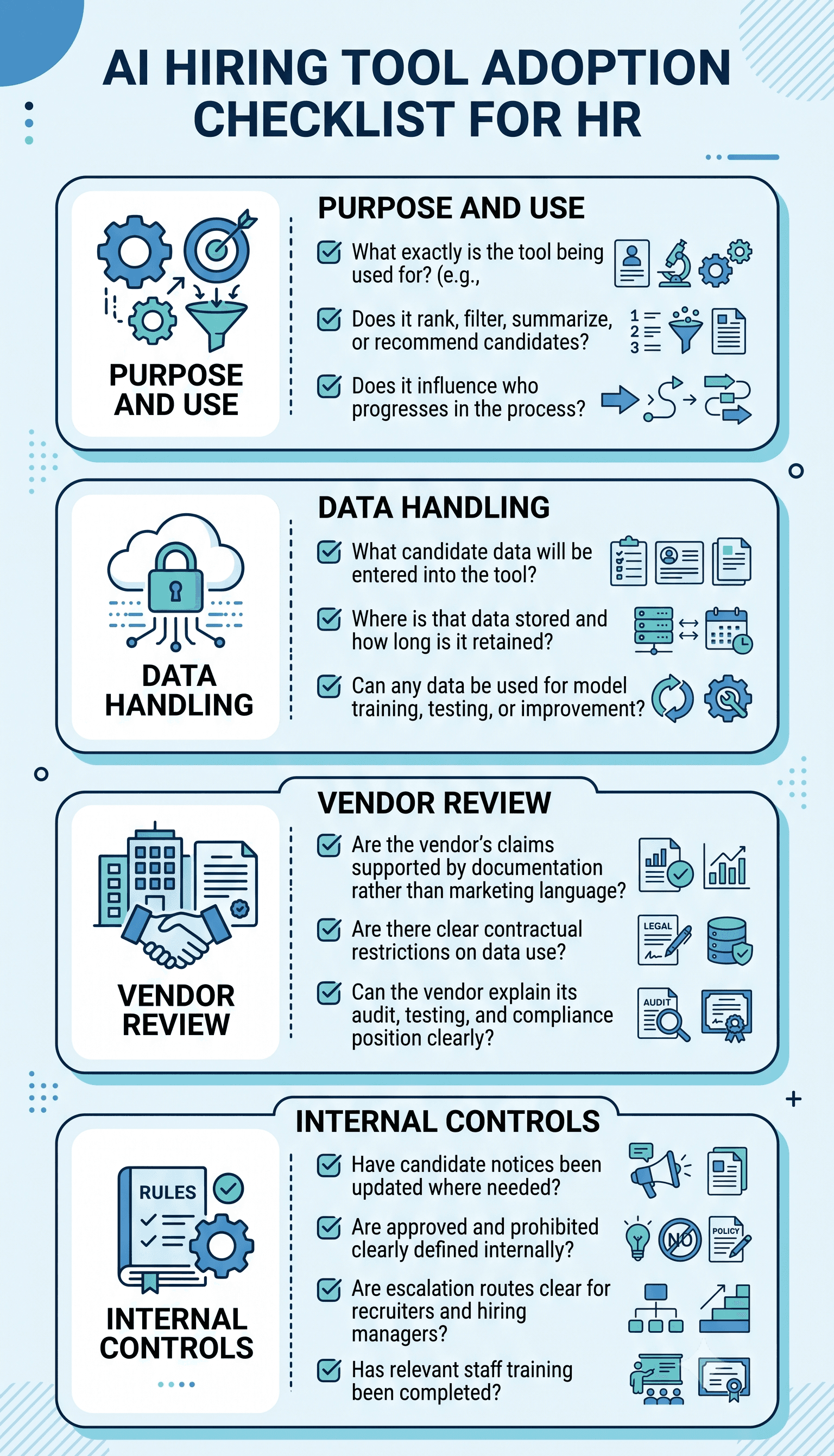
Checklist for HR Before Adopting an AI Hiring Tool
Before rollout, HR should be comfortable answering the following:
Purpose and use
What exactly is the tool being used for?
Does it rank, filter, summarize, or recommend candidates?
Does it influence who progresses in the process?
Data handling
What candidate data will be entered into the tool?
Where is that data stored and how long is it retained?
Can any data be used for model training, testing, or improvement?
Vendor review
Are the vendor’s claims supported by documentation rather than marketing language?
Are there clear contractual restrictions on data use?
Can the vendor explain its audit, testing, and compliance position clearly?
Internal controls
Have candidate notices been updated where needed?
Are approved and prohibited uses clearly defined internally?
Are escalation routes clear for recruiters and hiring managers?
Has relevant staff training been completed?
Training Priorities for Recruiters and Hiring Managers
Training is one of the most important controls in any recruitment AI framework. Even well-drafted rules will not be effective if recruiters and hiring managers do not understand when tools may be used, what risks they create, and what good workflow looks like in practice.
Training should not be limited to a policy overview. It should help users apply the rules in real hiring situations.
Topics to Cover
Local jurisdiction requirements relevant to the roles being hired for, including any rules on notice, consent, fairness, documentation, or automated decision-making. For instance, both Hong Kong and Singapore have AI-related guidance and privacy-protection materials relevant to organizations deploying AI with personal data.
Approved and prohibited uses of AI-enabled recruitment tools within the organisation.
Common pitfalls and risks, including over-reliance on rankings or summaries, use of unapproved tools, excessive confidence in vendor claims, limits of AI-generated candidate comparisions and recommendations, and poor handling of candidate data.
Good workflow practices for the specific tool or use case, such as when human review is required, what records must be retained, how summaries should be verified, what counts as meaningful human review, and when escalation is necessary.
Data handling and retention expectations, including what information may be entered into the tool, how outputs should be stored, and what deletion or retention rules apply.
Documentation expectations, especially where AI has influenced screening, assessment, or progression decisions.
Escalation routes, so that recruiters and managers know when to involve HR, Legal, Privacy, or IT to raise concern about inaccurate or skewed outputs.
Helpful Training Format
Many organisations find it useful to combine:
a short mandatory core training for all recruiters and hiring managers;
a practical written quick-reference guide;
role-based SOPs;
scenario-based training using common recruitment situations;
a one-page escalation map; and
periodic refresher sessions as tools, vendors, and legal requirements evolve.

A Note on Regulation and Enforcement Risk
Employers should also keep in mind that recruitment AI does not sit outside ordinary legal risk.
Depending on the jurisdiction and the way the tool is used, the organisation may need to consider discrimination law, privacy law, transparency obligations, vendor accountability, and audit or documentation expectations. In some places, automated hiring tools are receiving specific regulatory attention. In others, existing legal frameworks are being applied to new technologies in recruitment settings.
That means the risk is not limited to formal regulatory enforcement. It can also include complaints, internal investigations, reputational damage, and litigation where a process is seen as unfair, opaque, or insufficiently controlled.
Final Thought
Many organisations struggle with practical questions such as which tools are appropriate for which stages of hiring, how much human review is needed, what records should be retained, how local requirements affect the process, and when issues should be escalated internally. Even when the risks are understood, translating them into a workable framework can take time and coordination.
In that context, external support can be useful not simply for legal drafting, but for helping HR navigate the process more smoothly — bringing structure to internal discussions, pressure-testing workflows, and helping teams move from general concern to practical implementation.
1. What should HR review before adopting AI recruitment tools?
Before adopting AI recruitment tools, HR should review how the tool is actually used in the hiring process, whether it influences candidate ranking or progression, what candidate data it processes, how long that data is retained, whether the vendor can support its claims with documentation, and whether internal rules clearly define approved use, human review, escalation, and training requirements.
2. What are the main risks of using AI in recruitment?
The main risks of using AI in recruitment include over-reliance on automated rankings or summaries, use of tools that materially influence candidate decisions without proper oversight, poor handling of candidate data, unclear retention practices, weak internal governance, and inconsistent compliance with local legal or regulatory requirements. Risks can be legal, operational, and reputational, especially where AI affects screening, assessment, or hiring decisions.
3. How can HR teams govern AI hiring tools more effectively?
HR teams can govern AI hiring tools more effectively by defining clear use cases, separating approved and prohibited uses, requiring human review at appropriate stages, setting retention and documentation rules, updating candidate notices where needed, training recruiters and hiring managers on local jurisdiction issues and workflow expectations, and creating a clear escalation path for higher-risk use cases.